1. SPECIAL COVID CONSIDERATIONS
6. TECHNOLOGY including CELL PHONES, CAMERAS and COMPUTERS
1. SPECIAL COVID CONSIDERATIONS
Q. Will I be required to have a negative Covid-19 test result to join this tour?
A. At this time, you will not be required to provide a negative Covid-19 test result in order to participate in our tours. And Morocco does not require a negative Covid-19 test either.
We will provide you with all entry information in advance so you will be prepared.
Q. Do I need to have a negative Covid-19 test to return home?
A. Some countries may require a negative Covid-19 test prior to boarding your return flight home. Usually this is no more than 72 hours prior to boarding the flight. Alternately, in some cases, you may show proof of having recovered from Covid-19.
We will do our best to keep you apprised of this situation but, ultimately, it is your responsibility to abide by the mandates, laws and recommendations put forth by your country’s government. If a negative test is required, we will make time in the itinerary to get tested to ensure that anyone who needs one has results before departure.
Q. Will masks be required during this tour?
A. Masks will not be required during the tour. If, however, you find yourself with any symptoms that are associated with Covid, we ask that you mask up for the protection of others.
There are still inherent risks with traveling while Covid-19 is actively occurring and one’s health cannot be guaranteed by WanderTours.
2. GETTING TO MOROCCO
Q. What’s the best way to fly to/from Morocco?
A. Our tour starts in Casablanca and ends in Essaouira (where Marrakech is the closest international airport). You’ll definitely want to fly into Casablanca but it’s up to you whether you return from Casablanca or Marrakech. Flights can be comparably priced whether you fly round trip Casablanca or into one city (Casa) and out of another (Marrakech).
Q. Can I arrive early into Casablanca?
A. Definitely. And we’d be happy to book additional nights for you at the hotel where the group is staying for the start of the tour. Please check with our Client Liaison for pricing and availability.
Q. Do I need a visa to enter Morocco?
A. For citizens of many countries, you do not need a visa to enter Morocco. You will receive an entry stamp in your passport upon arrival. Here’s additional information about visas for Morocco:
Q. What is the best way to depart Morocco after the tour?
A. This tour starts in Casablanca and ends in Essaouira (close to Marrakech). We have detailed several options for you to connect with your international flight after the tour. While you are responsible for booking your own in-country flights (if you choose to fly back to Casablanca), WanderTours will make arrangements for your ground transportation after you decide the option that fits in best with your travel plans.
There are a number of options for leaving Morocco. We can book a car/shuttle to Marrakech for you (preferred option and included if your flight departs after 10 a.m.), we can book a car/shuttle to Casablanca for you, or you can fly from Essaouira to Casablanca (note that flights are limited).
We recommend that you schedule your flight for later in the day (on the final day) or early the following day so you don’t have to leave Essaouira too early. As an example, a 7 a.m. flight out of Marrakech would require that you leave Essaouira before 3 a.m. to get to Marrakech and checked in for your flight.
In our experience, most people will return to Marrakech, overnighting there for their early morning flights the following day. But this will all depend on flight availability post-Covid
Note that flights into Casablanca and out of Marrakech are often the same price as a roundtrip ticket to Casablanca, so unless you wish to spend more time in Casablanca we recommend that you fly out from Marrakech for the easiest option.
If you wish to fly into Casablanca and out of Marrakech:
1) We can arrange private transportation (car/shuttle) for you from Essaouira to Marrakech. If your flight from Marrakech leaves after 10am (recommended), there is no cost for airport transfer (NOTE: minimum of 3+ people is required for this transfer). If you need to fly out earlier than 10am, we can book a private transfer which is ~$385 per vehicle and fits 5-6 people depending on luggage (cost divided by the number of people traveling in the vehicle).
2) Although you can fly from Essaouira to Marrakech, flights are limited in terms of days of the week, and it will take longer to check-in, fly and get luggage than it would to drive (it’s a 2.5 hr drive).
If you wish to fly roundtrip from Casablanca:
1) We can arrange private transportation (car/shuttle) for you from Essaouira to Casablanca. The cost is divided by the number of people traveling in the vehicle (~$660 for 5-6 people depending on luggage). It’s a 5.5 hr drive, so for this option you must book your flights out of Casablanca after 12pm.
2) You can fly from Essaouira to Casablanca. At this time, flights are limited and we don’t know the days of the week flights may be available at the time of our tour. There is no charge for ground transportation to the Essaouira airport.
3. WHILE VISITING MOROCCO
Q. Will bottled water be readily available on the tour?
A. Yes it will, but we strongly urge our tour participants to carry their own reusable water bottle and bring a water purifier, such as a SteriPen, so as to cut down on the number of plastic water bottles that get thrown out daily in Morocco.
Q. What kind of food should I expect on the tour?
A. First and foremost, expect bread at every meal. Breakfast, lunch and dinner. Bread. A basket of bread. Delicious bread, of course!
Many meals start with a wide range of “salads” which could mean anything from a plate of olives to a mixed salad with rice. But not just one salad, all of them, all at once.
Tajine and couscous are often served as main meals and will include meat (beef, chicken or lamb) with vegetables OR just vegetables if you’ve requested vegetarian meals for the trip.
If you are gluten-free, it will be difficult (but not always impossible) to find gluten-free bread. It’s possible to eat well as a vegetarian / vegan but the food may get a little monotonous (usually veg tajine) so plan on supplementing with snacks / nuts / fruit.
If you prefer decaf coffee or tea, consider bringing your own because it’s rarely served in Morocco. The mint tea, ubiquitous here, is full-on caffeinated.
Q. When are meals typically served?
A. Typically, meals are served later than they are in North America. But we will do our best to eat at times that are more typical for North Americans (closer to 7pm and not 10pm, for example).
Q. Since this is a Muslim country, will alcohol be available?
A. Alcohol is definitely less common in Morocco than in many other countries but it will be available at a few of the hotels and at some restaurants. It’s also possible to purchase wine for your private consumption.
Q. Do you recommend any special vaccinations for this trip?
A. There’s nothing you need specifically for Morocco. However, you’ll want to consult with a travel doctor for medical advice.
Q. Do I need to be concerned about mosquitoes / malaria?
A. Malaria is not an issue in Morocco with the exception of some very rural areas (and we won’t be there). It’s unlikely that you’ll encounter mosquitoes but bringing a small amount of bug repellent might ensure you don’t see any 🙂
Q. What sort of toilets should I expect?
A. While most toilets will be western-style, there may be some restrooms where squat toilets are found.
Q. Will I need to pay to use public toilets?
A. As a matter of fact, yes. There may be times when an attendant at a public restroom expects or asks for a tip of 1 – 2 dirhams.
Q. How much walking is involved in this tour to Morocco?
A. All activities are listed on the itinerary page. In general, expect that our bus won’t be able to always park right next to the entrance of some of these ancient sites in which case we’ll need to walk to them. We will encounter cobblestone streets and uneven sidewalks. Also, there will be lots of steps (sometimes slippery) in Chefchouen and a short hike up to a hill to visit a mosque just outside the town of Chefchouen.
If you’re unsteady on your feet, you might consider bringing a walking stick or pole.
Q. Will it be cold when we are walking to the village near Imil?
A. The elevation in that area is 6,000+, so there is a potential for it to be cool enough that pants and shoes with socks will be more comfortable. You will also want a light jacket.
Q. The itinerary says there is an optional hike from Imlil. Is it difficult?
A. The hike isn’t necessarily “difficult” but we do walk up a hill/small mountain to get to the Berber village. It will take about an hour and 15 minutes and is quite lovely with some great views of snow-covered peaks. You might consider wearing hiking or walking shoes with some tread and ankle support.
Alternately, you will have the option to be taken up to the village via vehicle.
Q. I get motion sickness. Will I be able to sit in the front of the van/bus on the tour
A. We do try to make our tour participants as comfortable as possible, so please tell your tour guide if motion sickness is an issue for you. We can’t guarantee the front seat of the van or bus every time as it really depends on how many people in the group tend towards motion sickness or have other medical issues where they may need a different seat. We suggest that you bring ginger, wrist bands or ask your doctor about a prescription.
Q. What should I expect in terms of the weather?
A. Expect a diverse range of weather in Morocco. Though the weather during the summer months will definitely be quite hot, October and February will be quite bearable. It could be as high as in the 80s in some parts or as low as in the 40s in others (such as at night in the Sahara).
Q. Should I learn any Arabic before traveling to Morocco?
A. While it’s always great to learn a few phrases of the local language, you’ll find that most people we encounter will speak English as well as French and usually a hybrid of all three languages. Our guide will teach us some basics at the beginning of the trip.
4. HOTEL INFORMATION
Q. Do you know the name of the hotel the tour will be starting from yet?
A. Hotel information is listed on the tour itinerary, but we usually don’t have this confirmed until right before the tour (in case there are any last-minute changes). A complete hotel list will be provided a couple of weeks in advance of the tour start date and we encourage you to leave this with family and/or friends in case of an emergency. We can also book you a room in the same hotel where the tour starts if you wish to arrive early and explore the city on your own or rest from your travels.
Q. Will you be sending a list of hotels?
A. All of our hotels are listed on our itinerary and you will receive a list of hotel contact information about two weeks before departure (note: it is subject to last-minute changes).
Q. Will hotels have fitness centers and/or safe walking routes and will there be time to get some exercise?
A. Some hotels do have fitness centers but it’s best to check the hotel websites on the Morocco itinerary for specific amenities. You will also have several opportunities during the tour to explore on your own. In general Morocco is a safe country but it is quite conservative, especially when it comes to women. Check with your guide for the safest places to walk and consider going with someone else.
Q. Will the hotels provide shampoo and conditioner?
A. Most hotels will have shampoo and conditioner in the bathrooms. If you like, you can always purchase shampoo and conditioner once you arrive if you don’t want to travel with it or if you run out along the way.
Q. Are there hair dryers at the hotels?
A. Hair dryers should be available at all of the accommodations with the exception of the tented camp in the Sahara.
Q. Are my items safe in my hotel room?
A. Your items *should* be safe, but we recommend that you carry small luggage locks to secure the zippers together so that no one is tempted to peek in your bag.
When something goes missing, it’s usually later found in the bottom of one’s luggage. In the meantime, hotel staff are the first to be blamed. It’s best to keep your items (especially valuables) locked up so that this is not even a question.
Q. Can I make an appointment for a spa?
A. Yes, you can make an appointment directly with the hotel. The tour itinerary has links to all of the hotels so you can see which spa you’d like to choose. By going through the itinerary, you can also see where you’ll have the most free time. Fes is one good location.
Q. Will we have power in the tents at the Luxury Camp in the Sahara?
A. Yes, there’s definitely power in the tents (note: not enough to power a hair dryer!).
Q. Will there be heat in the tents at the Luxury Camp in the Sahara?
A. Yes, there is heat in the tents but for safety reasons, the proprietors prefer that these gas-powered heaters remain on only while you’re in the tent and only during waking hours. There will be plenty of blankets to keep us warm.
Q. Do the tents at the Luxury Camp in the Sahara have door locks?
A. Yes, there are locks on both the interior and the exterior of the tent doors.
5. PACKING INFORMATION
Q. Is it OK to have more than just a carry-on for the tour (in other words, checked bags)?
A. While you will be more comfortable moving around with fewer bags, you won’t be the only one with checked luggage. There will be porters and hotel staff to help with luggage at each destination and you’ll even have all of your bags with you during the trip into the Sahara (it will be transported by vehicle).
Note that not all hotels have elevators so the least amount of luggage you bring, the better.
Q. How should I dress/pack for this trip?
A. You’ll receive a full packing list for the tour that will help guide you. Because this is a Muslim country, you’ll want to dress a bit more conservatively than you might otherwise dress in a Euro-Mediterranean country, but basically you want to make sure that your shoulders and knees are covered.
Lightweight travel pants, capris, leggings, dresses and/or skirts (below the knee) will be most comfortable. Short-sleeved shirts, tank tops with a scarf to cover your shoulders or a long dress are all fine.
It will be cooler in the bus and in restaurants so do have a light jacket or wrap that you can wear. And it’ll be cool in the Sahara at night as well. In general, you’ll want to be prepared to dress in layers as the temperature can swing wide from mid-day to evening.
Q.What type of shoes should I bring?
A. Our rule of thumb is not to bring more than two pairs of shoes – one pair for walking and perhaps a pair of sandals, tennis shoes or small boots (depending on the weather forecast).
Because of the heat, you might find yourself wanting to wear sandals (ie. Tevas) even into the evening. But there will be a fair amount of walking around as we’re touring, so make sure your shoes are comfortable. And there will be an optional walk/hike in the Atlas Mountains that if you choose to do it (it’s about 2 hours), you’ll definitely want sneakers or light hiking shoes.
Q. Can I wear Tevas or Birkenstocks the entire tour?
A. If you’re comfortable wearing sandals like Tevas for walking all day, they are fine, but you may want to bring a pair of socks for the cooler evenings (or consider bringing another pair of shoes for evening).
Q. Will we bring our luggage to the Sahara?
A. Yes. We will be spending just one night in the Sahara and while we will be traveling to the tented camp via camel (optional), the luggage will be taken via vehicle.
Q. How do you fit everything into a carry-on and still have room for souvenirs?
A. We encourage you to pack light and do hand laundry along the way. You may then purchase a bag once in-country to bring home souvenirs.
Q. What type of daybag do you recommend for touring around?
A. Morocco is a relatively safe country but you’ll want to take extra precaution in the cities, particularly Marrakech. We recommend a shoulder bag or backpack that has safety features, such as one from PacSafe. Most of their bags have slashproof panels and handles so that an opportunistic thief can’t just grab your bag and run.
Q. Should I bring a swimming suit? Will there be time to swim?
A. There are swimming pools in several/most of the hotels on the tour and you will have some free time to use them, but it’s really personal preference.
6. TECHNOLOGY including CELL PHONES, CAMERAS and COMPUTERS
Q. Will WiFi be available at the hotels?
A. Yes, WiFi (usually free) is available at all of the hotels. It is available only in the dining tent at the Luxury Camp.
Q. What sort of power adaptor do I need?
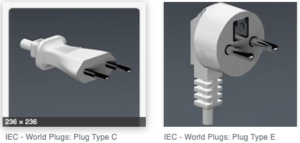
A. Morocco uses what’s considered a type C or type E power plugs. Your adaptor should look like this>>>
Q. Will I need a converter for my electrical devices?
A. You will need a converter for any devices needing 110/220 conversion (things like a hair dryer, curling iron, etc.). Most electronics these days (such as a laptop and iPad) have a built-in converter that protects the device from power surges.
Q. Can I use my cell phone in Morocco?
A. There are a few ways you can use your cell phone in Morocco. First, consider buying an international data plan from your provider. Most providers offer an international data plan where you purchase a certain amount of data and have a month to use it. You can use it for maps, internet, phone, texting, apps, etc.
Second, you can simply turn your data roaming off and only use your phone when there’s WiFi. If you require regular access to the internet, you could purchase a hotspot such as a Solis Skyroam where you’ll have your own personal WiFi connection.
Third, if you have an unlocked phone, you could buy a local sim card and use a data plan on the local network.
Q. Will I need to protect my gear from sand?
A. Yes, in the Sahara you’ll want to wrap your camera or other electronics in plastic bags to keep the sand from getting into them.
7. MONEY, GIFTS, TIPS
Q. What’s the currency used in Morocco?
A. The Dirham (MAD) is the currency of Morocco. Consider downloading an app such as Converter so that you have quick access to the exchange rate.
Q. Are ATMs available?
A. There will be ATMs available throughout the trip. You’ll want to let your bank know in advance that you are traveling so they don’t deny usage of your card thinking it’s a fraudulent charge. You’ll also want to find out what, if anything, your bank changes for international ATM withdrawals. If it’s based on each transaction, you’ll want to take larger amounts of money out rather than making numerous small withdrawals so as to limit the charges.
Q. How do I exchange money in Morocco?
A. If you have US dollars, Euros or British Pounds, you can exchange money at an exchange bureau upon arrival at the airport or at your hotel but the rate won’t be quite as good as exchange bureaus we’ll find elsewhere. Our guide can help find the best place to exchange your cash for local currency.
There is often a problem making change in Morocco, and it can be difficult to pay with large banknotes, so be sure to get smaller denomination bank notes (10s and 20s) as this will make your life easier when paying for inexpensive items such as drinks and souvenirs.
Q. How much money should I bring with me?
A. We get this question a lot, and it really does depend on your spending habits. You can make larger purchases using a MasterCard or Visa (American Express and Discover are not accepted as much), but small purchases will likely be made with cash. You might consider bringing $100-200 in case you have trouble finding an ATM that will accept your card when you first arrive. Also, having small bills (in your currency) to tip a taxi driver or bellman upon your arrival might be helpful.
Q. How should I best carry my money?
A. You might consider carrying your passport, credit/debit cards and cash in something like a neck pouch or a large wallet like this one from Baggallini. You could then put that in a larger cross-body bag.
Q. Is tipping appropriate?
A. The majority of tips for the driver/guide and any other guides for the tour are included in your trip cost. Having said that, small tips (US dollars or Dirham) for your waiter and for our driver/guide would be appreciated if they’ve gone above and beyond your expectations. We suggest consulting with the WanderTours escort during the tour for what might be an appropriate amount.
Q. Do you suggest we bring gifts for the locals?
A. It’s certainly a nice gesture (but not necessary) if you have small gifts to leave with friends you make along the way. Things that might be appropriate include souvenirs from your home town including items with logos (Seattle mugs or baseball caps, for example), chocolate or coffee. Check with our Client Liaison to see if our guide will be male or female so you can choose appropriately.
8. WANDERTOURS TRAVEL DETAILS
Q. Do I need insurance for this tour?
A. Until the pandemic has been declared over, we ask that all tour participants acquire travel insurance. We have now partnered with Travel Insured International so that you have ability to purchase “cancel for any reason” insurance. We HIGHLY recommend travel insurance (no matter who your provider is) to protect your travel investment from any future issues. Although we are technically not requiring it, you will be asked to sign additional paperwork acknowledging the risk of traveling without insurance.

Q. Is there a schedule for installment payments?
A. We don’t have anything formal set up but you can definitely send in payments on your own schedule. Some people send in monthly payments while other people send in payments when it’s convenient.
Q. Will I receive a refund if I have to cancel my participation in this tour?
A. Once you have paid a deposit, there is a cancellation fee if you cannot join us. The cancellation fee depends on the tour and how far in advance of the tour you cancel. Our refund policy is covered in our Booking Terms and Conditions and is also outlined on the Registration Form that you’ll receive within 24 hours of registering with a deposit.
Any refunds will be sent by check within two weeks of our receiving written notification of your cancellation (email notification is fine). We will respond via email and ask for confirmation of your mailing address for any refunds. Address must be confirmed within six months, otherwise expect forfeiture of refund as we close out our books at that time.
Q. Will you be sending an updated itinerary with our overnight accommodations so we can leave it with folks at home?
A. Yes, you’ll receive the hotel information as well as emergency contact information one or two weeks before departure (note: it is subject to last-minute changes).
Q. What’s the emergency contact info that I can give my family?
A. About two weeks before your departure, you will be given a cell phone number for your tour escort and someone in-country employed by our local tour operator.